Before AI saves you time, decide where it goes
Nobody I work with got less busy after AI. The teams who feel the difference chose ahead of time what the reclaimed hours were for.


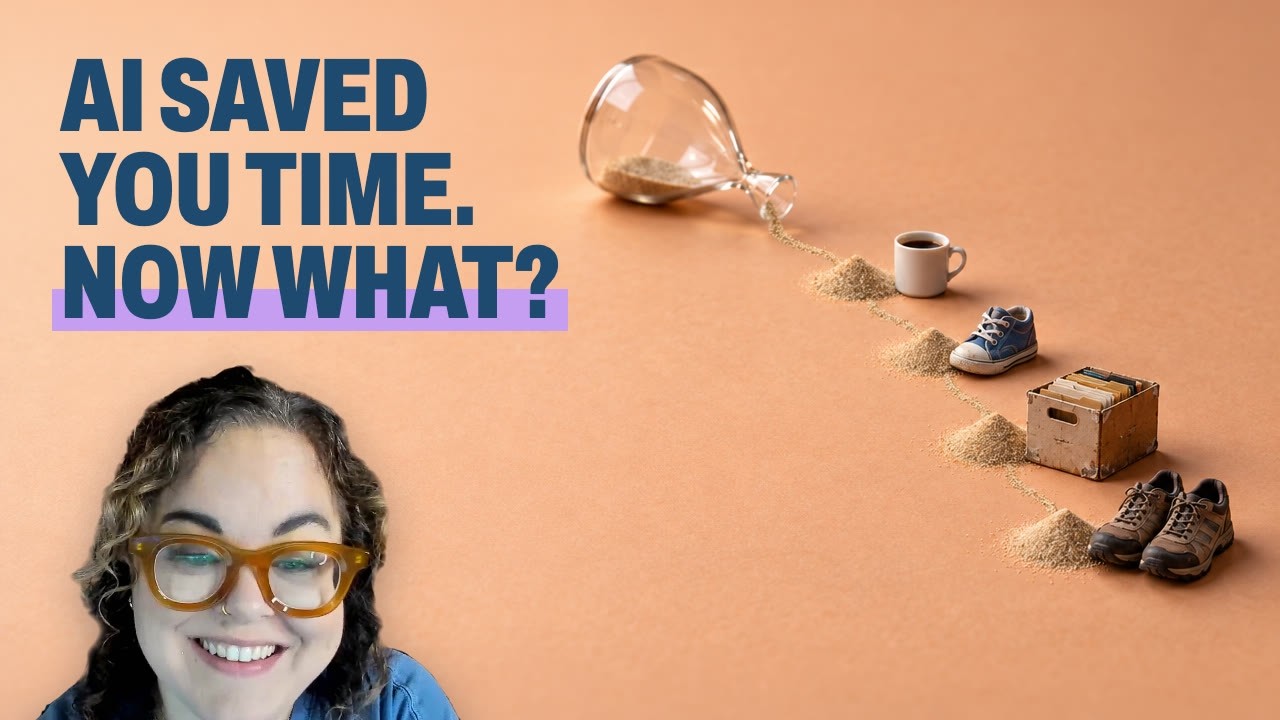
Do nonprofit teams actually get less busy when they use AI?
In my experience, no. Leaders a few months into AI first work tell me they're as busy as ever, because the needs in front of them keep growing. The hours really do come back. Whether your week feels different depends on a choice you make about where those hours go.
When I talk with leaders who've been at this a while, I keep hearing them say "we are no less busy than we've ever been." Less busy is possible. It's a choice, and most mission-driven people don't make it by default. Here's how I described what happens instead.
Colleen Cook · Recorded conversation, Sep 30, 2026So we don't become any less busy. We just make a micro choice about what needs of my time and attention next.
That micro choice is the whole game. If you make it on purpose, AI changes the shape of your work. If you leave it to the inbox, the inbox decides.
What happens if you don't decide where the time goes?
The time gets absorbed by more of the same work, and AI starts to feel like a treadmill. A faster tool makes it easy to say yes to one more report, one more campaign, one more meeting. Every yes is a no to something else, and without a plan the no lands on the things that matter most.
I named this early on, in one of the first conversations Scott and I recorded.
Colleen Cook · Recorded conversation, Sep 1, 2026the trap of AI if you're not using it intelligently is that it just becomes a hamster wheel that takes more and more from you
The intelligent version is to use what AI frees up to focus your energy on what will move the mission forward most, and to buy back some clarity and health for yourself while you're at it.
What should a nonprofit team do with the time AI gives back?
Point it at the work you got into this field to do. For most nonprofit people that means more time with donors, more time with your team, the mission problem you've postponed for years, and a life outside the office. Decide which one comes first before the hours show up.
I asked it as a set of questions, and I still use them with every team.
Colleen Cook · Recorded conversation, Sep 1, 2026Do you want to be connecting with more donors? Do you want to be more relational with your team? Do you want to be making sure you get home at five and taking lunch?
Use this as a worksheet with your team. Pick one row as your first destination, and write the hours next to it.
| Where the time could go | Question to ask your team | What it might look like |
|---|---|---|
| Donors | Who have we never had time to call, visit or thank properly? | A weekly block for personal calls and handwritten notes |
| Your team | Where are people stretched thin or isolated? | Real one-on-ones, shared lunches, cross-training |
| A postponed mission problem | What have we known needed fixing for years? | A small working group with protected hours |
| Strategy | What would we do next year if we had room to think? | A monthly planning session that actually happens |
| Rest | Who on our team is running on empty? | Leaving at five, taking lunch, a no-meeting morning |
Year-end is a good test. In September I told Scott what a team that set up its systems early could look forward to.
Colleen Cook · Recorded conversation, Sep 21, 2026you're not going to be buried in paperwork for the next two months you're going to be building matching gifts you're going to be building challenge gifts you're going to be building donor relationships
What does reinvested time look like at a real nonprofit?
It looks like people moving from tasks to relationships and long-delayed projects. At three different organizations I've watched the reclaimed hours go somewhere specific, and in every case someone decided where. None of them got less busy. They got busy with better work.
At one If Possible customer, the part-time communications director spent much of her week on social media and event logistics. Once the organization's intelligence layer was in place, they produced a month of content in an hour. Then she asked if we could do the same for the training events that ate her time, and we built an event management system that runs automatically. Basically all of her hours were given back to her. She put them into research supporting the president's new vision for the organization.
At another If Possible customer, a unified reporting system saved the team, by their conservative estimate, more than 280 hours a year on reporting alone. Scott called that "an entire month of a single person." What they did next is my favorite part. Their answer to the extra time was, as Scott tells it, "Might as well tackle that decades long problem".
Scott put the bigger pattern this way when we talked in September.
What do you do with that extra day in the week? What's really probably going to happen is you're going to reinvest it into the mission, into your nonprofit
And the third organization is ours. This fall I needed to build the community space for our cohort. In the past I'd have spent the whole weekend on it. "But instead, I hung out with my family this weekend."
How do you keep reclaimed time from disappearing?
Name the destination before the hours arrive, then protect it the way you'd protect a donor meeting. Put it on the calendar as a recurring block, tell your team what it's for, and check every week whether it happened. Reclaimed time without a home gets spent on whatever is loudest.
A simple weekly check-in helps. Here's a prompt to copy into your AI tool every Friday:
Prompt to copy: I'm going to tell you what AI took off my plate this week and where I said I'd put that time. Ask me three questions to find out whether the time actually went there. Then help me choose one specific block on next week's calendar for the thing that matters most, and tell me what I should say no to so that block survives.
If you need help with saying no, the overwhelmed fundraiser's guide to saying no is a good companion. And if you haven't freed up the hours yet, start with reclaim 5 hours a week with these AI habits. This article picks up where that one ends.
Is it okay to spend reclaimed time on rest?
Yes. If AI lets you do in eight hours what used to take 250, I think the honest question is what good stewardship of those resources looks like. Sometimes the answer is a donor visit. Sometimes it's going home on time so you can show up rested tomorrow. Both serve the mission.
Scott has a line that sounds backward until it clicks. "This is legitimately like why we want AI to be a part of your life so you can not have AI a part of your life." The point of the machine is more human time.
Leaders in a big shift like this one also need to ask, in the words I used with a nonprofit CFO, "where do we build in health and good, like, care for our teams in the midst of this big shift". Rest is part of that answer.
If you want your reclaimed time pointed at donors, a donor thank-you system that runs itself is a strong first destination, and aiming your year-end campaign shows how to put strategy time to work. You'll find more on protecting your hours on the time back hub.
If you want ideas like this in your inbox each week, join the newsletter. And if you'd like to build these systems, and decide where your time goes, alongside other nonprofit teams, get on the cohort waitlist.
Frequently asked questions
What should a nonprofit do with time saved by AI?
Decide before the time arrives. Most teams get the most from pointing it at donor relationships, team care, a long-postponed mission problem or strategic thinking. Rest counts too. Pick one destination, put it on the calendar as a recurring block, and check each week whether the time actually went there.
Will AI make our nonprofit team less busy?
Probably not on its own. Leaders I work with who are months into AI first work say they're as busy as ever, because needs grow to fill the space. The difference is in what they're busy with. Teams who choose where the time goes spend more of it on relationships and mission work.
How do we keep AI from just adding more work?
Treat reclaimed hours like a budget line. Name what they're for, protect them on the calendar, and review them weekly. When a new request shows up, ask what it would replace. Without that habit, a faster tool simply lets you say yes to more, and AI turns into a hamster wheel.
How much time can AI give back to a nonprofit team?
It depends on the task and on the systems you build. One If Possible customer estimates more than 280 hours a year saved on reporting alone, and a part-time staff member at another got basically all of her hours back. Your results will vary, which is why tracking your own hours matters.
Know an executive director who needs this?


